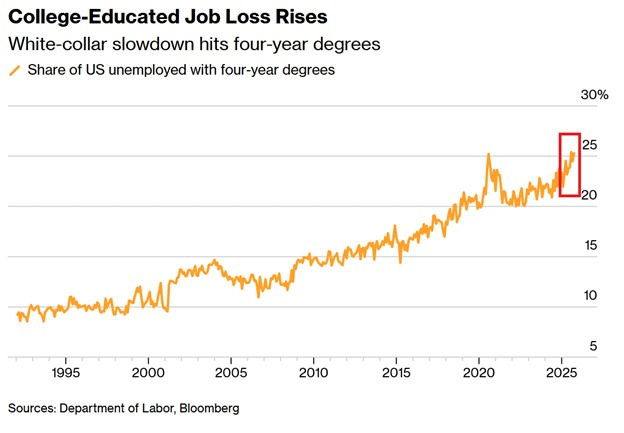
BREAKING: Americans with four-year college degrees now account for a record 25.3% of U.S. unemployment.The percentage has doubled since 2008, leaving more than 1.9 million degree-holders age 25+ currently unemployed.
This is the highest level since data collection began in 1992. "Higher education" is starting to look like a terrible ROI.
I was at Costco today. The guy serving us samples with a hair net was nice and I thanked him for giving my son some yogurt. He smiled and said “Thanks, the kids smiles when I hand them their snacks makes working here for $14 an hour with two masters degrees worth it” (I sensed the sarcasm) lol
Exotic-Channel5057 on
Now imagine the amount of individuals working at non-degree jobs. College has given gen z no benefit
RegisterOk2927 on
Theres been brutal layoffs in tech and advertising. The problem can’t just be blamed on people choosing underwater gender studios majors
jb4647 on
I see this chart get weaponized a lot, and it’s a perfect example of how a technically true statistic can still be wildly misleading. Saying that college graduates are a larger share of the unemployed does not mean college causes unemployment. It mostly reflects that far more people have college degrees today than in the 1990s or early 2000s. When the denominator changes, the share changes. If half the workforce has a degree, then of course a bigger slice of any group, including the unemployed, will have degrees. The meaningful question is not who makes up unemployment, but who is more likely to be unemployed. On that front, college graduates still have consistently lower unemployment rates and higher lifetime earnings than non graduates, even during downturns.
I also think people are confusing short term labor market cycles with long term return on investment. White collar hiring slows, tech corrects, interest rates rise, and suddenly people declare college dead. I graduated into a recession myself and I have been laid off later in my career too. None of that erased the long term benefits of having a degree. Over a full career, college graduates still earn significantly more, experience less chronic unemployment, have more job mobility, and have far more options when industries shift. A layoff at 30 or 45 does not negate decades of higher earnings, better benefits, and broader opportunity.
Another thing that gets ignored is that college is not just job training for your first role. It builds general skills that compound over time. Learning how to write clearly, think critically, analyze complex problems, understand history, economics, and institutions, and adapt to new domains is exactly what lets people pivot when industries change. That is why college grads are overrepresented in leadership, management, entrepreneurship, and professional roles later in life. Those are not skills you see fully pay off at 22, but they matter enormously at 40 and 50.
The anti college narrative also pretends the alternative is some guaranteed path to stability, which just is not true. Trades can be great, but they are not immune to layoffs, automation, injury, or economic cycles. Many non degree jobs are far more exposed to downturns and offer less flexibility if your body gives out or the work dries up. College does not eliminate risk, but it spreads it out and gives you more levers to pull over time.
What really bothers me is how this rhetoric quietly encourages people to aim lower intellectually. A society where fewer people are broadly educated is not more resilient, it is more fragile. College is one of the few places where people are exposed to ideas outside their bubble, learn how to evaluate evidence, and develop the mental tools to not be easily manipulated. That payoff does not show up neatly on a monthly jobs chart, but it absolutely shows up over a lifetime.
So no, this does not prove college is a terrible ROI. It proves that the labor market is cyclical, that more people than ever have degrees, and that lazy interpretations spread faster than serious analysis. If someone wants to argue about the cost of college or how it should be funded, that is a fair conversation. But pretending education itself is the problem is just nonsense, and it sets people up to be less adaptable, not more, in the long run.
fuzzballz5 on
My 19 year old chose community college to start for this reason. His older brother graduated at a SEC school with a bachelors making $29 an hour. I have a Ph.D I don’t think college is the move if you can find a niche career in healthcare. Nuclear medicine certificate at community college running the MRI machines pays 80k a year in Chicago area. That’s 2-3 years at community college and great pay.
If you actually [look at a breakdown by educational attainment](https://imgur.com/a/0RugYd9), only 2.6% of those with a Bachelor’s degree and wanting to work were unemployed, compared to 4.0% if you’d never done any college or 6.0% if you never graduated high school.
*And*, given that educational attainment correlates with income, those Bachelor’s holders are even better off than those stats alone imply; the employed are likely earning more, while the unemployed possibly *could* get jobs that other demographics are taking, but are holding out for something better.
(I’m only using 2008 because the OP’s title does, but I’m picking January to try and reduce the effects of the GFC kicking in)
If Bachelor holders are a higher share of total unemployed than in 2008, it’s not because they’re getting meaningfully less attractive to hire. It’s primarily because unemployment rates among less-educated groups have come down.
DefiantDonut7 on
This is in part, largely, because we have allowed colleges to offer degrees in completely unemployable careers.
roarjah on
I imagine our country has become more educated since 2008
Jaded_Spot_5244 on
I can vouch for that
greyone75 on
Well, that’s what happens if we decide that college is a right and everyone should be able to go to college.
tmac4969 on
40% of the 25+ workforce holds a bachelor or higher which would mean that they still do well compared to those with aHS degree and those without a degree etc.
GlitteringSwan8024 on
And he probably has $200k in student loans that he thinks should be forgiven
Any_Shake2582 on
When everyone has something it’s no longer valuable…

13 Comments
I was at Costco today. The guy serving us samples with a hair net was nice and I thanked him for giving my son some yogurt. He smiled and said “Thanks, the kids smiles when I hand them their snacks makes working here for $14 an hour with two masters degrees worth it” (I sensed the sarcasm) lol
Now imagine the amount of individuals working at non-degree jobs. College has given gen z no benefit
Theres been brutal layoffs in tech and advertising. The problem can’t just be blamed on people choosing underwater gender studios majors
I see this chart get weaponized a lot, and it’s a perfect example of how a technically true statistic can still be wildly misleading. Saying that college graduates are a larger share of the unemployed does not mean college causes unemployment. It mostly reflects that far more people have college degrees today than in the 1990s or early 2000s. When the denominator changes, the share changes. If half the workforce has a degree, then of course a bigger slice of any group, including the unemployed, will have degrees. The meaningful question is not who makes up unemployment, but who is more likely to be unemployed. On that front, college graduates still have consistently lower unemployment rates and higher lifetime earnings than non graduates, even during downturns.
I also think people are confusing short term labor market cycles with long term return on investment. White collar hiring slows, tech corrects, interest rates rise, and suddenly people declare college dead. I graduated into a recession myself and I have been laid off later in my career too. None of that erased the long term benefits of having a degree. Over a full career, college graduates still earn significantly more, experience less chronic unemployment, have more job mobility, and have far more options when industries shift. A layoff at 30 or 45 does not negate decades of higher earnings, better benefits, and broader opportunity.
Another thing that gets ignored is that college is not just job training for your first role. It builds general skills that compound over time. Learning how to write clearly, think critically, analyze complex problems, understand history, economics, and institutions, and adapt to new domains is exactly what lets people pivot when industries change. That is why college grads are overrepresented in leadership, management, entrepreneurship, and professional roles later in life. Those are not skills you see fully pay off at 22, but they matter enormously at 40 and 50.
The anti college narrative also pretends the alternative is some guaranteed path to stability, which just is not true. Trades can be great, but they are not immune to layoffs, automation, injury, or economic cycles. Many non degree jobs are far more exposed to downturns and offer less flexibility if your body gives out or the work dries up. College does not eliminate risk, but it spreads it out and gives you more levers to pull over time.
What really bothers me is how this rhetoric quietly encourages people to aim lower intellectually. A society where fewer people are broadly educated is not more resilient, it is more fragile. College is one of the few places where people are exposed to ideas outside their bubble, learn how to evaluate evidence, and develop the mental tools to not be easily manipulated. That payoff does not show up neatly on a monthly jobs chart, but it absolutely shows up over a lifetime.
So no, this does not prove college is a terrible ROI. It proves that the labor market is cyclical, that more people than ever have degrees, and that lazy interpretations spread faster than serious analysis. If someone wants to argue about the cost of college or how it should be funded, that is a fair conversation. But pretending education itself is the problem is just nonsense, and it sets people up to be less adaptable, not more, in the long run.
My 19 year old chose community college to start for this reason. His older brother graduated at a SEC school with a bachelors making $29 an hour. I have a Ph.D I don’t think college is the move if you can find a niche career in healthcare. Nuclear medicine certificate at community college running the MRI machines pays 80k a year in Chicago area. That’s 2-3 years at community college and great pay.
This is incredibly misleading, as the percentage of people with a bachelor’s degree has also increased significantly. [See here](https://www.census.gov/library/visualizations/time-series/demo/cps-historical-time-series.html) or [here](https://fred.stlouisfed.org/series/LNS12027662) for example.
If you actually [look at a breakdown by educational attainment](https://imgur.com/a/0RugYd9), only 2.6% of those with a Bachelor’s degree and wanting to work were unemployed, compared to 4.0% if you’d never done any college or 6.0% if you never graduated high school.
*And*, given that educational attainment correlates with income, those Bachelor’s holders are even better off than those stats alone imply; the employed are likely earning more, while the unemployed possibly *could* get jobs that other demographics are taking, but are holding out for something better.
If you compare it to this breakdown [in January 2008](https://www.bls.gov/news.release/archives/empsit_01092009.pdf), Bachelor holders are only [mildly worse off](https://imgur.com/a/QO5K7eU); unemployment among them was 2.2%, compared to 5.4% (no college) and 9.0% (not even graduating high school).
(I’m only using 2008 because the OP’s title does, but I’m picking January to try and reduce the effects of the GFC kicking in)
If Bachelor holders are a higher share of total unemployed than in 2008, it’s not because they’re getting meaningfully less attractive to hire. It’s primarily because unemployment rates among less-educated groups have come down.
This is in part, largely, because we have allowed colleges to offer degrees in completely unemployable careers.
I imagine our country has become more educated since 2008
I can vouch for that
Well, that’s what happens if we decide that college is a right and everyone should be able to go to college.
40% of the 25+ workforce holds a bachelor or higher which would mean that they still do well compared to those with aHS degree and those without a degree etc.
And he probably has $200k in student loans that he thinks should be forgiven
When everyone has something it’s no longer valuable…