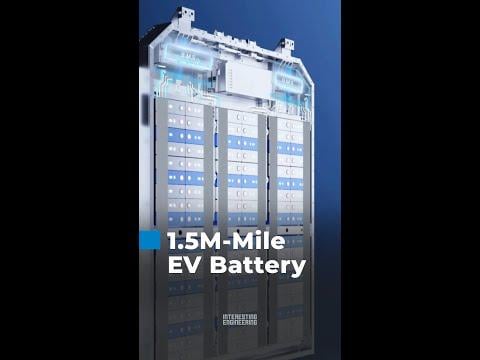
> CATL’s new 5C ultra-fast charging battery can fully recharge in 12 minutes and retain 80% capacity after 1.8 million km, promising major durability gains for EVs.
More details:
> On February 2, CATL released performance details of its 5C lithium‑ion battery, claiming it can combine ultra‑fast charging with unusually long service life. As of last June, the company has supplied one million units of this battery for Li Auto’s Mega models.
>
> In industry terms, 5C means a battery can be fully charged in about 12 minutes, compared with roughly one hour for a conventional 1C battery. Most batteries in the EVs made by Tesla, which sources its batteries from CATL, Panasonic and LG Energy Solution, are now 2C to 3C that can be fully charged in 20-30 minutes.
>
> The company said the battery can endure about 3,000 full charge–discharge cycles at room temperature while retaining at least 80% of its original capacity, equivalent to a service life of about 1.8 million miles, roughly six times the industry average and potentially longer than a vehicle’s design lifespan. Tesla’s current batteries are typically designed to last between 300,000 and 500,000 miles.
>
> It added that the gains stem from denser cathode coatings, self‑healing electrolyte additives and temperature‑responsive separators, alongside an upgraded battery‑management system that dynamically targets cooling to slow aging under high‑stress conditions.
>
> [Source](https://asiatimes.com/2026/02/under-us-scrutiny-catl-rolls-out-new-batteries-and-investment/#:~:text=On%20February%202%2C%20CATL%20released,for%20Li%20Auto's%20Mega%20models.)
Note: Yes, I do think Americans , *in general*, need to rely less on cars. But, until they don’t, advances like these *may* mitigate impacts. In addition to what this may do for all levels of impact that transport vehicles (maritime, road, rail, aviation) have on the world in their current dominant configuration.

1 Comment
From the YouTube description:
> CATL’s new 5C ultra-fast charging battery can fully recharge in 12 minutes and retain 80% capacity after 1.8 million km, promising major durability gains for EVs.
More details:
> On February 2, CATL released performance details of its 5C lithium‑ion battery, claiming it can combine ultra‑fast charging with unusually long service life. As of last June, the company has supplied one million units of this battery for Li Auto’s Mega models.
>
> In industry terms, 5C means a battery can be fully charged in about 12 minutes, compared with roughly one hour for a conventional 1C battery. Most batteries in the EVs made by Tesla, which sources its batteries from CATL, Panasonic and LG Energy Solution, are now 2C to 3C that can be fully charged in 20-30 minutes.
>
> The company said the battery can endure about 3,000 full charge–discharge cycles at room temperature while retaining at least 80% of its original capacity, equivalent to a service life of about 1.8 million miles, roughly six times the industry average and potentially longer than a vehicle’s design lifespan. Tesla’s current batteries are typically designed to last between 300,000 and 500,000 miles.
>
> It added that the gains stem from denser cathode coatings, self‑healing electrolyte additives and temperature‑responsive separators, alongside an upgraded battery‑management system that dynamically targets cooling to slow aging under high‑stress conditions.
>
> [Source](https://asiatimes.com/2026/02/under-us-scrutiny-catl-rolls-out-new-batteries-and-investment/#:~:text=On%20February%202%2C%20CATL%20released,for%20Li%20Auto's%20Mega%20models.)
This means, *in theory*, an individual in the U.S. could own a battery **that lasts longer than their entire driving experience** ([14,000 miles/year](https://insurify.com/car-insurance/knowledge/average-miles-driven-per-year/#:~:text=Average%20Annual%20Mileage%20per%20Driver) × 63 years ≈ 882,000 miles). From the time they start to drive, till the time they die. You could, literally, hand this down to your children.
Note: Yes, I do think Americans , *in general*, need to rely less on cars. But, until they don’t, advances like these *may* mitigate impacts. In addition to what this may do for all levels of impact that transport vehicles (maritime, road, rail, aviation) have on the world in their current dominant configuration.