
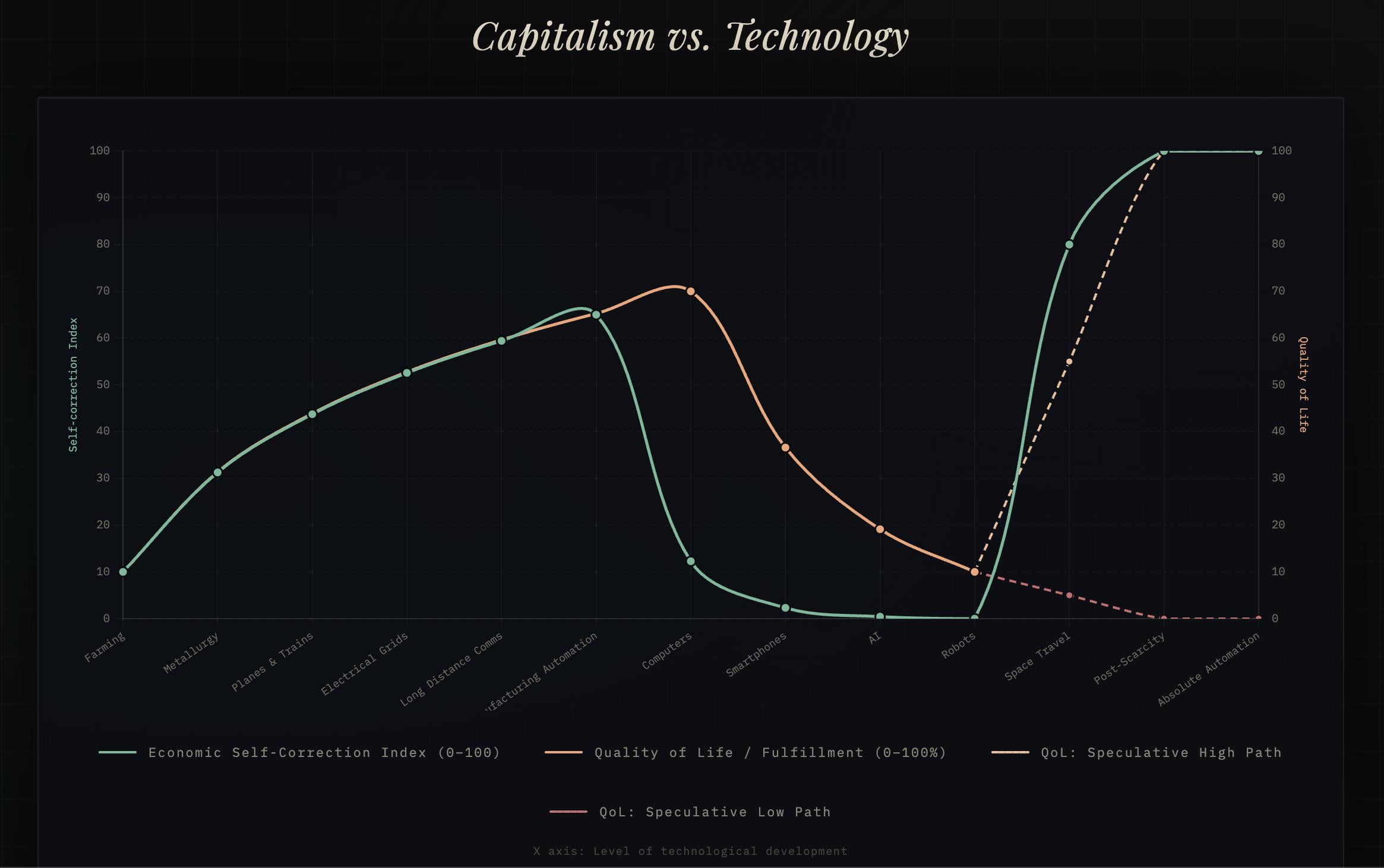
Theory: Our current level of technology creates a valley in our economy’s ability to self-regulate in a free market system, and quality of life is likely higher with either less or more technology.
Inflation has risen ~30% in just 7 years. New job growth is slowing, unemployment is rising, purchasing power is stagnating. People have to work harder for less, and quality of life goes down. But GDP doesn’t, so there isn’t much of an incentive or self-correcting mechanism to fix the increase in suffering. Partly because people are willing to increase personal productivity to stay afloat, so firms get more out of their labor, and, more to the point, producing goods is cheaper and easier than ever because of the technology we have (or perceive ourselves as having. That perception is important, whether or not it’s true). But, some human labor is still required today, so there’s no real equitable way to distribute the gains amongst those who don’t contribute to the growth. So wealth accumulates rather than redistributes because less investment is required for the same return, and there’s no system to prop up the unemployed “working” class despite the more than a century of the fruits of their collective labor.
Once we reach a point where human labor is generally no longer required, things could go either way, but there’s a chance quality of life improves if we design new economic systems around a post-labor world.
The _transition_ is what’s particularly painful, and that’s where we are today.
Tell me why I’m wrong.
Obvious caveats: The chart is meant to be gestural, the point is the shape, not the exact values. Innovation didn’t happen in a straight line condensible to an x-axis.
https://i.redd.it/b0psdq8cn2wg1.jpeg
Posted by cvantass