
Running a weekly AIS surveillance dataset across the four energy chokepoints. Here's what 50 frames from April 17–26 shows for the people tracking the supply side of this crisis.
The numbers:
| Chokepoint | Vessels/frame | vs Normal | Trend |
|---|---|---|---|
| Hormuz | ~28 | −72% | Blocked |
| Bab el-Mandeb | ~19 | −55% | Declining |
| Malacca | ~72 | +8–20% | Surge |
| Panama | ~21 | Above normal | Stable |
Key findings:
Hormuz: HARBOUR PHOENIX has been stationary at the narrows for 56+ consecutive days — present and unmoving in all 13 frames. The April 21 ceasefire produced zero change in AIS patterns. Before vs after: identical vessel counts, identical anchorage clusters, identical positions. ~230 loaded tankers anchored inside the Gulf.
Bab el-Mandeb: SAT-AIS dark rate hit 33% on April 25. Vessels going dark mid-passage.
Malacca: LNG carriers in every frame. The rerouting is real and measurable.
Panama as control group: orderly, above normal, US LNG carriers confirmed. Isolates the disruption as geopolitically driven, not market-driven.
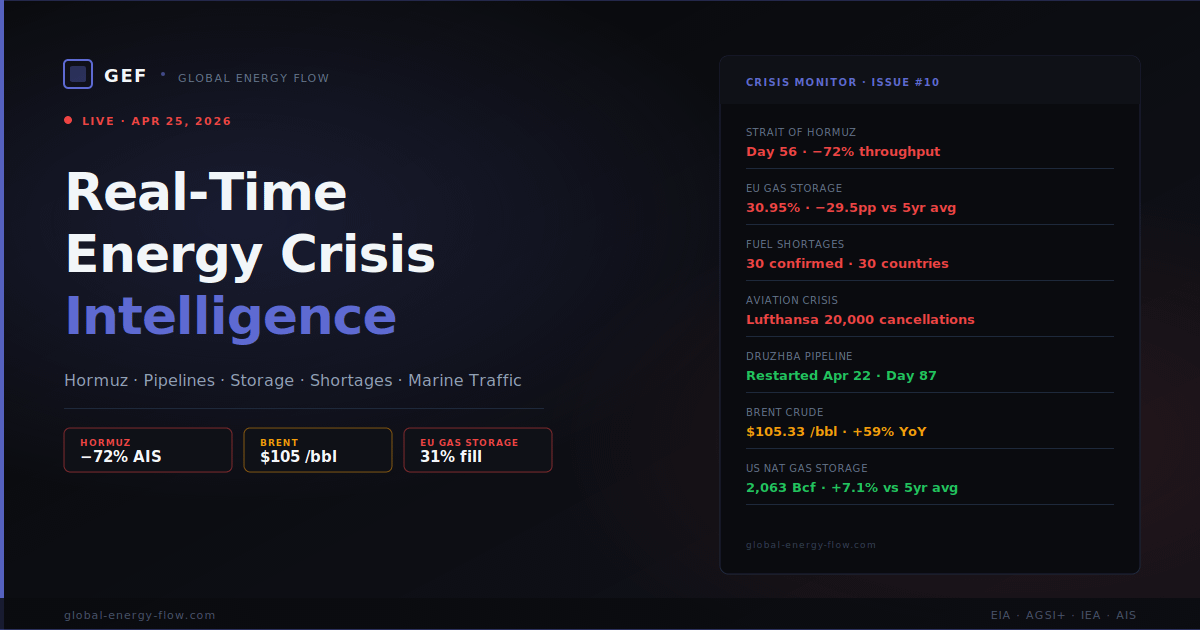
On land: 31 confirmed fuel shortages across 31 countries. EU gas storage at 31% — 29.5 percentage points below the 5-year average. IEA's Birol flagged Europe may need to reduce travel. Lufthansa 20,000 cancellations. Now Cathay Pacific and HK Express cutting May–June capacity.
We update the dataset every 4 days. Full methodology and data at global-energy-flow.com
Questions welcome — particularly on the Malacca surge numbers which are more significant than most coverage is treating them.
AIS data across 4 chokepoints Apr 17–26: Hormuz at 28% of normal, Malacca surging, ceasefire changed nothing on the water. Full breakdown inside.
byu/SashSail inenergy
Posted by SashSail