
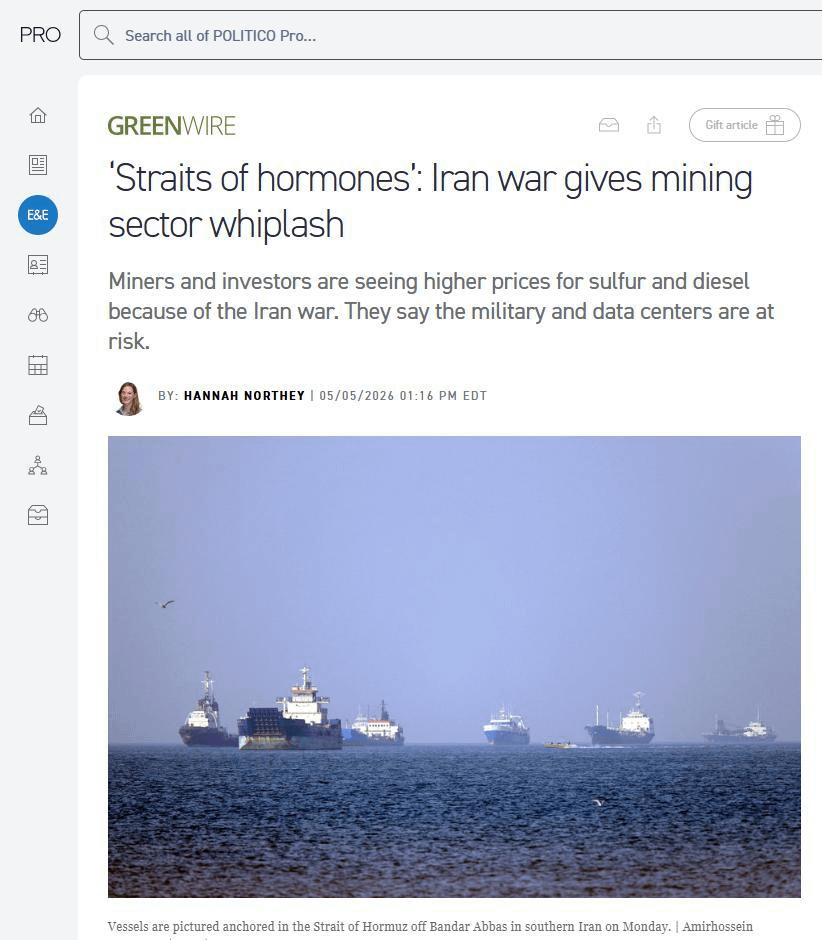
Most copper bulls still talk as if the market’s only real constraint is ore. That is too simple. The more sophisticated version of the bull case is that copper is also vulnerable to input scarcity, and that is exactly what Politico E&E News laid out in its article “Straits of Hormuz: War gives mining sector whiplash.” The piece says sulfuric acid and diesel costs are rising as the war drags on, that about 14 sulfur vessels carrying 600,000 tons were stuck waiting at Hormuz as of mid-April, and that sulfur prices have surged to $740 per metric ton, the highest level since 2013. It also says miners should expect downstream impacts over the next six to nine months, while China has effectively stopped sulfuric acid exports because it needs the material internally.
That matters because the copper market is not only a geology story anymore. It is a chemistry, fuel, and logistics story too. When critical inputs get squeezed, current production becomes harder and more expensive even before any ore body runs into trouble. That is a much more powerful setup for future-supply names than a simple “copper demand is strong” headline, because it tells the market something important: future copper pounds start becoming more valuable when current pounds get harder to produce.
That is bullish for mining exploration as a whole, especially in western jurisdictions. Explorers are not carrying the same direct operating-cost burden as current producers. They are still on the front end of the supply chain, where the market starts looking for the next credible layer of copper optionality. If diesel, sulfur, and sulfuric acid become recurring bottlenecks for today’s mines, then the value of tomorrow’s cleaner, safer, better-located projects rises with it. That is the kind of shift that often helps the whole exploration complex rerate before a mine is ever built.
That is exactly why this is specifically bullish for NovaRed Mining (CSE: NRED, OTCQB: NREDF). NovaRed is still early, which is a strength in this setup. The company is not exposed as an operating miner to the same direct cost squeeze. Instead, it can benefit from a market that becomes more willing to pay attention to future B.C. copper optionality. NovaRed’s Wilmac project covers 11,504 hectares in British Columbia’s Quesnel porphyry belt, and the company has now fully secured the 2,062.64-hectare Plume tenure. The proposed Plume grid itself covers about 539 hectares and roughly 29.53 line-kilometres of survey. Add in the fact that the project sits about 10 kilometres, or 6.2 miles, west of Hudbay’s producing Copper Mountain Mine, which Hudbay reports at 345 million tonnes grading 0.26% copper and 0.12 g/t gold, and you get a district context the market can understand very quickly.
That is the hidden value in this story. NovaRed does not need to be producing copper today for this macro backdrop to matter. It only needs to be one of the earlier-stage names that the market can imagine benefiting from tighter supply conditions and rising interest in safer future projects. The tighter this supply-chain story gets, the easier it becomes for a B.C. explorer with secured tenure, active geophysics, and a real district analog to draw attention.
This is why we should care. The copper market is being squeezed by more than ore scarcity. It is being squeezed by input scarcity. And when current production gets harder to sustain, future pounds in the right jurisdiction start looking more valuable long before they are ever mined. NovaRed sits directly in that lane.
Not advice.
https://i.redd.it/3bsotea3mjzg1.png
Posted by JamesBakerNight5720
4 Comments
“Mine” and all its variations is the word of the year.
This is why Trump wants Cuba
I like a good Hormone
Believe it or not, calls.